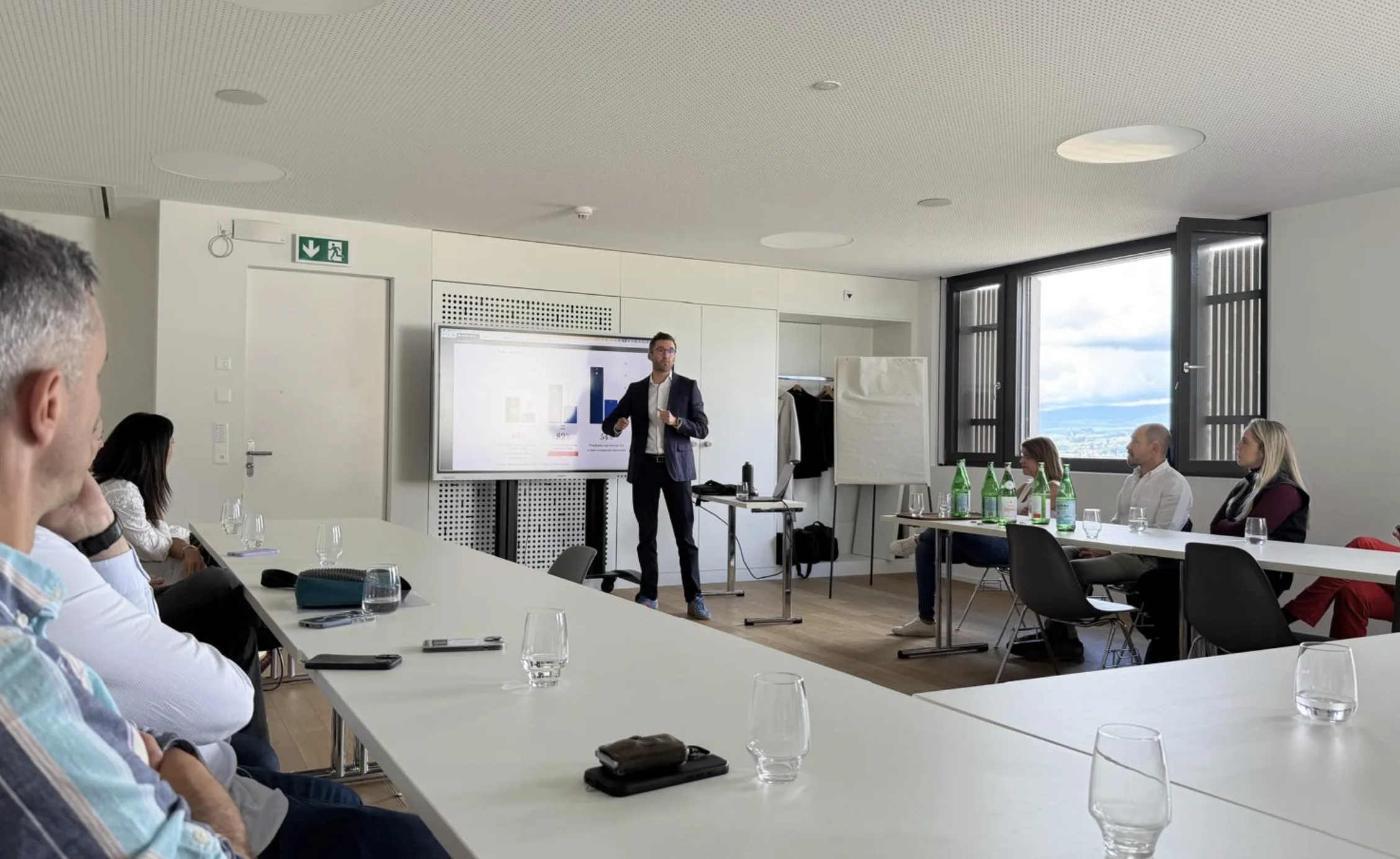
AI Conference at GJD Lausanne
Lausanne
A concrete, story-led session on what AI already changes for professionals: less hype, more workflows, and a clear insistence on context, confidentiality, and review.
79
judges once needed to decide an Olympic sprint finish
46%
of Swiss companies using AI in the adoption figures discussed
3
steps in every useful workflow: capture, process, produce
150
spoken words per minute, making voice a serious AI interface
From Olympic timing to knowledge work
The talk started with a simple shift everyone understands: Olympic judging moved from many human eyes to precise camera timing. Romain used that transition to frame what is happening in offices today. Many cognitive tasks are still done manually, but the equivalent of the camera is arriving for contracts, meetings, emails, proposals, and professional knowledge work.
The founder story behind Whisperit
Romain connected the topic to his own path: software engineering, several startup attempts, and the concrete legal workflow that became Whisperit. The first prototype was built to solve a practical problem for lawyers: turn dictated notes into usable, structured work without the slow handoff from recorder to manual transcription.
A practical model for AI
Instead of treating AI as magic, the conference broke it down into three moves: capture information, process it with the right context, and produce something useful. That model covered dictated notes, meeting summaries, action lists, email drafts, document drafting, and connected workflows that can work across files, CRM data, inboxes, and team tools.
Control, security, and professional judgment
The session did not ignore the risks. Hallucinations, confidentiality, poor context, and unchecked outputs were presented as the real failure modes. The answer was practical: provide source material precisely, use secure infrastructure for sensitive data, restart drifting conversations, and keep human validation in the loop.
Full event note
Romain gave a conference for GJD in Lausanne on a direct question: is artificial intelligence a tool or a threat?
The session opened with an analogy from Olympic sprint timing. A century ago, dozens of judges were needed to decide a finish by eye. Today, a camera can measure the result with far more precision. The same shift is now happening in knowledge work: reading contracts, summarizing meetings, drafting proposals, processing emails, and turning unstructured information into usable outputs.
Romain then connected that transition to his own path as a founder: from software engineering and failed startup attempts to the moment Whisperit emerged from a concrete legal need. Lawyers were still dictating notes, handing recordings to assistants, and waiting for manual transcription. Whisperit started as a two-week prototype to turn voice into structured legal work, then quickly became a product used by law firms and notaries.
The talk broke AI down into a simple operating model: capture information, process it with the right context, and produce something useful. That framework was illustrated through everyday examples: a dictated note becoming a structured CRM entry, one meeting producing a summary, action list, and follow-up email, and connected AI workflows that can read documents, synthesize a client file, draft a response, and notify a team.
The conference also covered the risks that matter in professional environments: hallucinations, confidentiality, weak context, and the need for human validation. Romain emphasized practical safeguards: provide the exact source material, use secure and Swiss-hosted options for sensitive data, give precise instructions, restart conversations when they drift, and review outputs before relying on them.
The final part moved from theory to live demonstration, showing how voice can accelerate drafting, email replies, meeting records, and document generation inside Whisperit. The core message was pragmatic: experienced professionals are not made obsolete by AI. When they know their domain and keep control of the review process, AI can make them faster, sharper, and better equipped for larger, more complex work.